David and Lili's World Tour

- HOME PAGE
- GLOBALOCITY
- 2003
- USA
- Russia
- NW India
- Nepal
- Central India
- 2004
- Thailand
- Cambodia
- Vietnam
- Laos
- China
- Philippines
- Malaysia
- Indonesia
- Spain
- Portugal
- England
- France
- USA
- Puerto Rico
- 2005
- Brazil
- South Africa
- Lesotho
- Swaziland
- Mozambique
- Malawi
- Tanzania
- Rwanda
- Ethiopia
- Egypt
- Jordan
- Israel
- Palestine
- 2006
- England
- France
- Germany
- Denmark
- USA
- 2007
- Mexico
- Guatemala
- Honduras
- Nicaragua
- Costa Rica
- Panama
- Brazil
- England
- Netherlands
- Czech Republic
- Italy
- Vatican City
- Switzerland
- Portugal
- Spain
- Morocco
- 2008
- USA
- Hawaii
- New Zealand
- Fiji
- 2009
- New Zealand
- Brazil
- Bolivia
- Peru
- 2010
- USA
- New Zealand
- Japan
- French Polynesia
- Australia
- 2011
- USA
- Thailand
- Cambodia
- Tonga
- 2012
- New Zealand
- Tonga
- 2013
- China
- 2014
- New Zealand
- Australia
- Timor Leste
- Indonesia
- Singapore
- Malaysia
- Cambodia
- Thailand
- Myanmar
- NE India
- 2015
- South India
- Sri Lanka
- Thailand
- Indonesia
- China
- United Kingdom
- Belgium
- Holland
- Germany
- Poland
- Lithuania
- Latvia
- Estonia
- Sweden
- Denmark
- Turkey
- Greece
- Italy
- Portugal
- Argentina
- Uruguay
- Paraguay
- 2016
- Brazil
- USA
- Brazil
- Colombia
- Maui
- Japan
- 2017
- New Zealand
- Oregon
- 2018
- New Zealand
- Polynesia
- Rapa Nui / Chile
- Kenya
- Uganda
- Egypt
- Holland
- France
- Italy
- Austria
- Hungary
- India
- Myanmar
- 2019
- Taiwan
- 2022
- Brazil
- USA
- 2023
- New Zealand
- Polynesia
- Thailand
- 2024
- Canada
- USA
- Rarotonga
- 2025
- New Zealand
- Vietnam
- China
- ...
- ALOHA
- Obtober 2025 - China and Tibet
Ni Hao! We love traveling in China, and every time we visit, the country is more convenient, friendly, modern, clean, and with a stronger economy. Even the public toilets are clean now! And of course the food is marvellous. The younger generation now speaks basic English, and we have AI technology too! Wow, it so much fun to talk to people like was never before possible. And yes, we can access the global Internet now too, because our phone eSIM work similarly to a VPN in that it bypasses the Great Firewall.
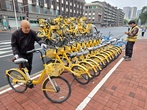
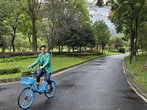
And that phone is essential, because cash is rarely used (but still useful). Certain phone apps are basically mandatory: WeChat, Alipay, Amap, an eSIM such as Nomad, Google Translate, and a paid subscription to an AI like ChatGPT. WeChat and Alipay link to overseas bank cards, so we can pay for everything with a QR-code scan, including Didi taxis, city bikes, and street food. It's so easy! We needed cash only in underground metro stations to buy tickets because our Internet didn't work there. Also cash is still king in Tibet.
Our journey took us from Vietnam into China at Lao Cai, then to Jianshui, Chongqing, Dujiangyan, Chengdu, Xining, and finally to Lhasa and Shigatse Tibet, the Mount Everest base camp, and finally Nepal. What a great mission!
 |
 |
 |
 |
 |
 |
 |
 |
 |
 |
 |
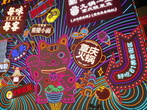 |
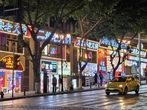
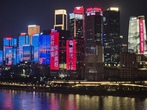
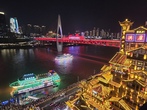
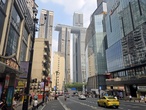
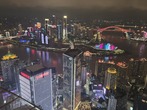
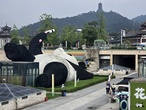
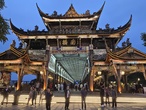
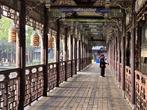
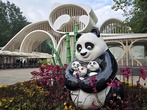
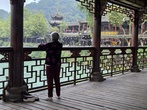
Highlights; Chongqing is one of the world's largest municipalities with 32 million people! Have you even heard of it? Wow. This place is ultra-modern and cool. Check it out next time you are in the neighborhood. Chengdu is great for bicycling around, so easy! Go see pandas at Dujiangyan, a nice ancient city (the panda base in Chengdu is too crowded). Arriving from Vietnam we stopped in Mengzi, a nice and chill town with great food and zero tourists. Then we stopped in a nearby ancient town called Jianshui to feel that old-school China vibe. The main attraction for this trip however, was certainly TIBET.
Ahhh... the trains! The network is vast, fast, clean, and punctual, so easy! China has by far the world's largest High-Speed Rail system (about 48,000 km and still growing), and we went all the way to Lhasa across the Tibetan plateau. See below for more on Tibet... Or read now about China's economy and politics...
 |
 |
 |
 |
 |
 |
 |
 |
 |
 |
 |
 |
The USA is in decline while China shines. This is the China Century! The Western media and blog bros would have you believe that China's rise is a bad thing, because China is a Communist Dictatorship! They have ubiquitous spyware, a diabolical social credit score, they want to invade Taiwan, their fishing bottom trawlers are destroying the oceans, they are the top emitter of greenhouse gasses, and the people don't have free speech or other basic freedoms, especially minority groups. BUT ... Some of these points are exaggerated or false, and this narrative is misleading because it is relentlessly negative. To dig into this, let's compare China to the USA...
Point number one: FREEDOM. This includes speech, safety, mobility, privacy, and economic access. China maximizes order, safety, efficiency, and progress at the cost of political speech and privacy. The USA maximizes expression and pluralism while sacrificing safety, privacy, coherence, and good governance. The classic mistake in the Western media is to pretend that Freedom is equivalent to a free press and democracy, only.
America hasn't felt free since the Patriot Act passed, just after 9/11, when it traded constitutional protections for security theatre: warrantless surveillance, indefinite detention, no-fly lists without due process, militarized police, and normalized rights violations. The NSA's bulk data collection, revealed by Snowden, showed the government reading emails and tracking phones, and it has only gotten worse with the latest spyware. The USA lectures China about freedom while maintaining the world's largest prison population.
So let's talk more about FREEDOM...
Freedom of speech: China: Yes, speech is restricted, and the Chinese people are well aware of the red lines, such as criticizing the party, discussing the Tiananmen Square massacre, organizing protests, or challenging core policies. Censorship is real and ideological, but practical problem solving and feedback channels do exist within those boundaries, on a case by case basis.
This begs the question: Is China justified in restricting freedom of speech if that helps the government to do a better job? After all, it is hard to manage 1.5B people, especially while maintaining an amazing unity and order generally. Our observation is that most Han Chinese would agree the restrictions are worth the benefit, especially compared with the USA, which is a very easy target for Chinese media to make look bad.
So let's compare China with the USA more then... Under the Donald, freedom of speech is broad and guaranteed on paper, but in practice not so much. And it is getting worse, with book bans, voting rights rollbacks, anti-protest legislation, culture war pressure on schools and textbooks, ICE crackdowns and direct attacks agaist the mainstream media by uber-wealthy Trump allies and the right-wing authoritarian regime. Aggregious examples abound. This is a very serious problem. Freedom of speech in the USA also means freedom to spew total bullshit, and the anti-science movement is genuinely harmful. Disinformation thrives unchecked. This is corrosive to democracy, and a threat to the whole world order.
Freedom to travel: China: High Speed Rail is the default; dense and punctual metros abound; shared bikes and taxis are easy; everywhere feels safe, even at night. USA: Long distance travel requires flying or driving. It is an expensive and sucky experience.
Freedom of physical safety: China: There is extremely low street violence, instead there is visible order in public spaces, with lots of happy people out enjoying the night air. This safety comes partly from heavy surveillance, strict gun control, and the state's capacity to suppress disorder. That's a trade-off that the Chinese people themselves seem happy to accept.
USA: Guns! So many guns. America has mass shootings, crime, and fear. Now with ICE raids, a nightmare for anyone who speaks Spanish. Attempts at gun regulation get blocked, and the security state focuses on surveillance theatre instead of addressing root causes. Do not go out alone at night in many places. This is a core freedom that MAGA Americans fight to maintain. Woohoo.
Freedom of privacy: China: There is no national social credit score, as is widely reported. This is a myth. The truth is that the sensational Western media have pushed this narrative and invited speculation. What actually exists today is a patchwork of legal compliance databases, corporate score systems for e-commerce, and blacklists for specific violations. Financial credit reporting lives in its own lane. Punishments are tied to real legal violations. This system is decentralized, uneven, evolving, and not a unified moral grade for your life. That said, surveillance is real and extensive: facial recognition is ubiquitous in cities, internet activity is monitored, the Great Firewall requires workarounds (we needed an eSIM to access the global internet), and WeChat data is accessible to authorities. For some minority groups especially, the oppression is real and can be suffocating.
USA: Corporations and the government scoop vast data on everyone. TSA security theatre, no-fly lists, border device searches, social media monitoring, facial recognition, and license plate readers are normalized. It is a different model from China, but with the same surveillance pressure, and perhaps better branding. America just outsources this stuff to corporations and calls it "terms of service." By the way, the orange one has given a corporation called Palantir many millions since he took office to fund Billionaire Peter Thiel's vision: compile everything the government knows about every person, and not for benevolent purposes.
Other points of comparison:
Poverty, homelessness, and health care In the USA, poverty is loud and visible, with sprawling tent cities, people living in cars and begging on street corners. Over 770,000 Americans are officially homeless, a record high, and a majority of renters are struggling paycheck to paycheck. Meanwhile, health care costs are absurd and regularly bankrupt people (about 500,000 per year). That's not freedom.
In China, it's different, not because poverty doesn't exist, but because it doesn't sprawl into the public space. We didn't see homeless or beggars, nor tents, encampments, or drug addicts. Official stats list hundreds of thousands of relief actions every year, meaning forced shelter or relocation. The chengguan (urban enforcers) keep public order tidy. It's clean, it's strict, and it works. And here's the part nobody talks about: over 90% of households in China own property. Yes, ghost apartments are real, but so is stability. Most Chinese people don't fear eviction. They don't skip medicine. Clinics are cheap. Pharmacies are everywhere. People can actually go see a doctor without a GoFundMe. The point isn't that China has no poor. It does. But it doesn't abandon people to chaos. There is order. There is dignity. And there is a floor below which one is not allowed to fall. This is socialism, paid for by state-owned enterprise profits, plus mandatory insurance contributions, plus tax and central redistribution.
Infrastructure and execution: China: Decide, design, build, operate. Big projects show up. Engineers are in charge, not lawyers. High speed rail stitched the country together in a decade. City metros spread like tree roots. Ultra-high voltage power lines move wind and solar power to the coastal load centers. And so much more. When they say they will add a new station, or a new bridge, it will get done quickly. This speed comes from authoritarian efficiency: the state can override local objections, relocate people, and direct resources without endless litigation.
USA: Hearings, lawsuits, funding fights, NIMBY protests, and rich people refuse to pay tax to fund public infrastructure. Dysfunctional governance and bad politics are the norm. Concrete examples are everywhere: Bridges that crumble, long past their design life, while committees debate. Transmission lines blocked, so clean power gets stranded. Environmental review used as a weapon, not as a tool to build wisely. No high-speed rail. American exceptionalism?
Climate and emissions: China: China leads the world in renewable energy deployment and electric vehicle adoption, with record solar and wind buildouts, grid batteries scaling fast, EVs going mainstream, and electrified rail cutting travel emissions. Yet China is still the world's largest emitter and continues building coal plants. Two truths coexist: China is both climate leader and climate problem. But to be fair, the emissions per capita are below the USA, even as China manufactures stuff for the whole world to consume.
USA: Clean energy is growing, but record oil production, airports instead of rail, and car-dependent sprawl keep emissions sky high. Republicans are rolling back climate rules, gutting EV support, and slashing funding for the EPA and other scientific bodies, undercutting progress and threatening global climate targets. Meanwhile it subsidizes fossil fuels and exports climate denial as policy. The hypocrisy is staggering.
International posture: China: The Belt and Road program feels tangible on the ground, with new rails, ports, and stations appearing across developing countries, and a recent shift toward greener infrastructure projects. Debt-trap diplomacy concerns are real, where countries struggle to repay Chinese loans. Taiwan remains status quo, a threat, not a war. BRICS is expanding membership and pushing alternatives to the Bretton Woods dollar system, challenging Western financial dominance. This is not a threat to the world, but an alternative to Washington's dominance since World War Two. Again, this is the China century, and while imperfect, they will do a better job of leading the Earth than Washington.
USA: America talks about rules-based international order, then refuses to join the very treaties and conventions it expects others to follow. The list of global treaties that America has not ratified or has withdrawn from is staggering: UNCLOS, CEDAW, CRC, CRPD, ICESCR, Convention on Biological Diversity, Nagoya Protocol, Basel, Rotterdam, Stockholm, Comprehensive Nuclear-Test-Ban, Arms Trade Treaty, Mine Ban, Cluster Munitions, Kyoto Protocol, Rome Statute, and still pending the High Seas Treaty. Another example: the war in Iraq. America uses its UN Security Council veto regularly to block resolutions it dislikes. America backed Israel's war against Palestine despite being a friggin' genocide, and now it is bombing boats in the Caribbean and threatening Venezuela. Hypocrisy is the American international brand. The Republicans have made it very clear now that all they really care about is power so that they can be as rich and corrupt as dictators like Putin.
Education: USA: Good for the rich, bad for the poor. Grossly expensive universities.
China: Strong basics in math and science, a serious exam culture, and a relentless focus on study make Chinese well educated and curious. Urban schools tend to be better resourced than rural ones, though investment is narrowing that gap. After-school cram culture is a thing. Vocational tracks are expanding alongside universities, and English is taught widely. Net result: a system that is intense, competitive, and increasingly effective at scale.
The downsides: debt and demographics: China's infrastructure boom has a cost. Local government debt sits around $7-10 trillion USD (America's debt is much larger). The problem: years of building to meet growth targets, with losses hidden rather than written down. Ghost cities and overcapacity are real. The trains run, but the balance sheets are stressed. The demographic time bomb is worse. China is ageing quickly. The workforce is shrinking, pensions are strained. Long term, fewer people on this overcrowded planet will be good, but for now, the demographics and debt problems are serious. On labour: independent unions are not permitted, and strikes are restricted. Workplace conditions have improved dramatically over decades, but power imbalances remain.
Finally, regarding minorities: policies vary. Some groups receive affirmative action in education. Others face restrictions on language, religion, and movement. Han migration into minority regions has changed demographics and culture. This is real, ongoing, and contested. We saw first hand how the Tibetans feel oppressed in their own land, but the situation for the Uyghurs is even worse. Some well-travelled members of our Tibet tour group were just in the Uyghur region of Xinjiang, and they observed the most heavy security of anywhere on Earth (with the possible exception of Palestine). The official excuse is that there have been jihadist attacks and the Uyghurs are Muslim extremists, but the response is cultural genocide. China simply will not allow Islamic terrorism on its soil, and will prevent it, period.
To summarize: Let's be precise: China is a left-leaning one-party state with a market economy and technocratic governance. The USA is a quasi-democratic republic with increasing dysfunction, polarization, and authoritarianism under Republican leadership. We don't soft-pedal what China is. We argue that effective governance matters, and that the American system, gridlocked, corrupt, captured by donors, and increasingly hostile to its own democratic norms, is failing its people. It is ironic that the red hat cultists say Make America Great, while they are undoing the very things that make it great: public education, infrastructure investment, scientific research, international cooperation, and the rule of law. Meanwhile, China actually is great. This is their century. China is one of the easiest countries in the world in which to travel: cities feel very safe, infrastructure is modern, and everything is highly organized. The downside is heavy surveillance and tight control over information and politics, which you mostly feel in what you can't access online or say in public, not in your day-to-day sightseeing.
Want to learn more about China? Go there! Ride the trains. Bike the greenways. Eat the noodles. Watch a clean and safe megacity coordinate itself with a QR scan. China shows what a left-leaning single-party government can achieve. By the way, ditto Vietnam (refer to previous post)...
 |
 |
 |
 |
 |
 |
 |
 |
 |
 |
 |
 |
 |
 |
 |
 |
 |
 |
 |
 |
 |
 |
 |
 |
- TIBET
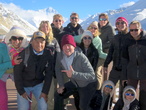
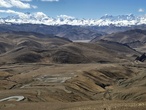
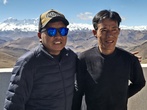
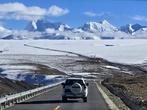
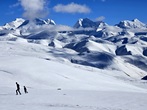
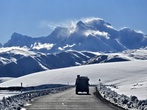
We booked a tour to cross Tibet because we had to. Foreigners are not allowed to travel independently (except in Lhasa city, where we spent three days before our tour). One needs a licensed agency to get permits to visit Tibet, and that means a fixed itinerary, a guide, and a driver. This is not our usual travel style, but we got lucky, because our group was made up of real travelers, not tourists, with zero wheeled luggage, instead just backpacks. We had a fun group :-) We had long dreamed of taking this route to India by land from China, crossing the high Himalayas and then dropping down into Nepal, and yes, it was epic! Indeed it was deeply satisfying.
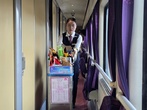
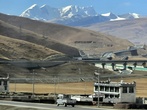
The train ride to Lhasa from Xining was surreal. Outside the window we saw yak pastures, frozen rivers, and brown emptiness, punctuated by massive infrastructure projects.
The railway is both an engineering miracle and a political instrument. It brings medicine, goods, and tourists. It also brings surveillance, control, and troops. Two truths coexist. The Chinese state has invested billions into roads, housing, infrastructure, and poverty reduction. And the same state restricts movement, speech, and religion.
We saw first hand how Tibetans spoke in code to avoid saying words in public such as His Holiness the 14th Dalai Lama (one guy told us to simply say HH instead). They are afraid of the heavy-handed consequences if they break the rule, so they don't break the rule. The guy told us that Lhasa is a nice city, but the Tibetans feel strangled. That word stuck with us as we toured around and saw all the strict control for ourselves.
Here's the background: the People's Liberation Army entered Tibet in 1950, and after the failed uprising of 1959, the Dalai Lama fled to India. Now his photo is banned in China, and his teachings are tightly restricted. He is officially described by the CCP and the state media as a separatist figure and part of a terrorist clique linked to Tibetan independence movement. We disagree with that assessment.
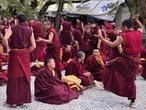
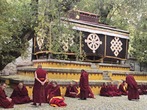
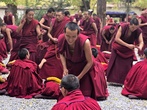
In 2008, protests erupted across Tibet and nearby provinces, and the response was swift and brutal. Since then, the surveillance and control increased. Every monastery now has party monitors. Every monk is registered. Pilgrimage is allowed, but loyalty is demanded. Foreigners must be in a tour group.
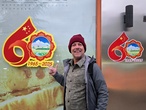
This year marks the 60th anniversary of the founding of the Tibet Autonomous Region (TAR) under the People's Republic of China, and this fact was heavily promoted everywhere, with many thousands of banners, stickers, flags, and billboards, everywhere, a celebration! This is pure propaganda of course, because 1965 marked the institutionalization of Chinese control and the suppression of real Tibetan autonomy.
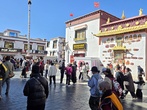
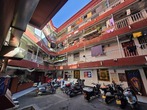
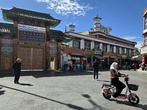
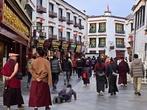
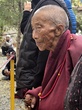
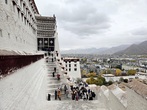
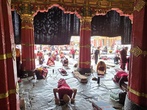
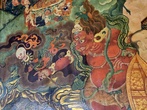
The old quarter of Lhasa feels like a different country, with a separate language, culture, religion, race, art and architecture. This was a Buddhist kingdom for centuries, ruled by lamas. That changed when the People's Liberation Army arrived and the current Dalai Lama escaped to India. Most monasteries were destroyed or severely damaged during the Cultural Revolution. Many people were killed. We spoke with Tibetans who told us clearly: they love to meet Westerners like us, but the Chinese, not so much.
Beijing has reshaped Tibet. In Lhasa, Han Chinese now make up a large share of the city's population, and Shigatse, the second city, also feels like modern China, not Tibet. The state encourages migration, and it works. Tibet is too strategic. The water and the minerals are too important to ever let go.
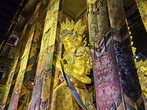
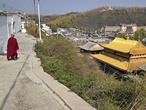
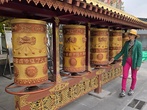
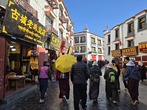
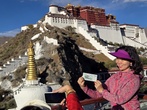
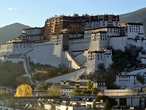
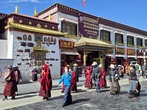
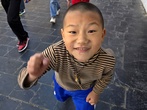
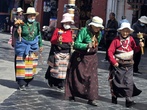
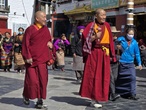
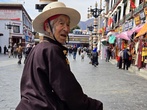
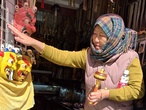
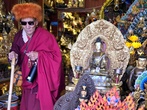
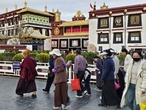
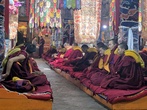
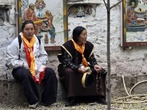
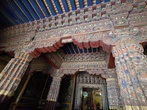
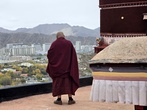
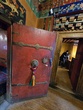
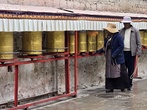
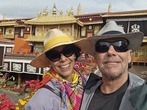
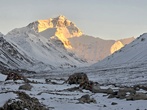
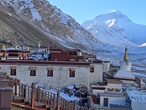
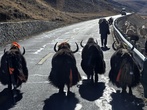
So yes, Tibet is majestic. The monasteries glow red and gold in the high mountain light. Friendly and kind pilgrims walk clockwise around the Jokhang temple with prayer wheels in hand. Children play in the alleyways. But the silence is noticeable, and the rules are visible. We are so happy that we were able to walk in this land, meet the people, and absorb the positive energy of the great Tibetan nation, a fabulous experience overall, a real highlight. Oh yeah, we saw the sunset on the north face of Mount Everest too, which was stunning. Tashi Delek.
 |
 |
 |
 |
 |
 |
 |
 |
 |
 |
 |
 |
 |
 |
 |
 |
 |
 |
 |
 |
 |
 |
 |
 |
 |
 |
 |
 |
 |
 |
 |
 |
 |
 |
 |
 |
 |
 |
 |
 |
 |
 |
 |
 |
 |
 |
 |
 |
 |
 |
 |
 |
 |
 |
 |
 |
 |
 |
 |
 |
 |
 |
 |
 |
 |
 |
 |
 |
- Previous: Vietnam . . . Next: Nepal ... India ...
- PS: I wrote a novel: Globalocity - The Adventures of Raymond. Go around the world with an attitude, and a secret sub-plot. Go with Raymond. Globalocity gets excellent reviews because it is interesting and engaging, fun fiction. Global velocity! This book will grab you and take you for a ride. Check it out.